No doubt, the “10 blue links” era of Google is dying. If you have spent the last decade perfecting the art of ranking #1 on a Search Engine Results Page (SERP), I have some news that might be hard to swallow. Ranking #1 does not matter if the user never clicks a link.
Welcome to the era of AEO (Answer Engine Optimization).
Google is increasingly answering questions directly on the page via SGE (Search Generative Experience). And if you have found yourself asking Gemini or ChatGPT for a recommendation instead of scrolling through ads, you have already encountered an “Answer Engine.”
As a writer or a brand, your goal has shifted. You are no longer just optimizing for a search engine. You are optimizing to be the source of the AI’s answer.
In this guide, we will look at what AEO is and how you can optimize your articles to be cited in AI overviews and GPT’s responses.
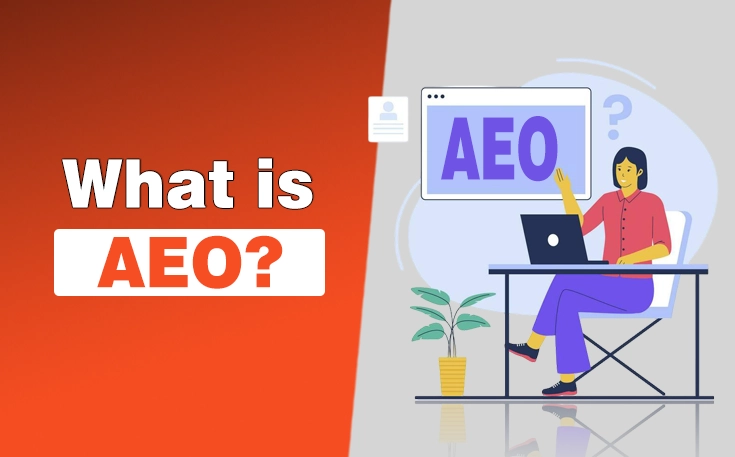
What is AEO?
AEO (Answer Engine Optimization) is the process of optimizing content to be the direct response provided by AI-powered engines like Gemini or ChatGPT.
It prioritizes clear, structured, and authoritative data to satisfy specific user intents within AI-generated overviews and snippets.
Evolution of SEO to AEO: The Death of the “Click” and the Birth of the “Answer”
The primary pain point for every digital marketer in 2026 is the Zero-Click Search. Statistics show that over 60% of mobile searches now end without a click to a website. Why? Because the search engine solved the problem on the spot.
For years, we treated Google like a post office. It just delivered the mail. Now, Google is the recipient that reads the mail and tells the user the summary. This is a nightmare for traffic, but a massive opportunity for brand authority.
If your brand is the one the AI cites, you aren’t just a “link.” You are the Source of Truth.
The Core Entity: What exactly is an “Answer Engine”?
Traditional search engines (SEO) use crawlers to index pages based on keywords. Answer Engines (AEO) use LLMs (Large Language Models) and Neural Networks to synthesize information.
They don’t just find a page; they understand the intent behind the query using NLU (Natural Language Understanding).
How Do You Optimize Content for AEO?
In 2026, it is extremely important to optimize your content for AEO so you can get more citations in Google’s AI overview and the answers generated by LLMs, like ChatGPT, Gemini, Perplexity, Grok, and others.
Below, I am going to mention all the tactics that you can follow, as I have implemented them on my site and am now getting the results.
1. The Big Shift: From Keywords to Entities
To understand AEO, we have to talk about Entities. In the old days of SEO, we obsessed over keyword research and finding high-volume and low KD keywords. If you wanted to rank for “best SEO tools,” you said “best SEO tools” 15 times in an article.
Today, Google and other LLMs (Large Language Models) don’t just look at words. They look at relationships. An entity is a person, place, thing, or concept that is distinct and well-defined.
Why Entities Matter for AEO?
When an AI like Gemini tries to answer a query, it looks at its Knowledge Graph. It asks:
- Is this source an authority on the entity “SEO tools”?
- Does this content mention related entities like “Content Gap,” “Domain Rating,” or “Page Authority”?
If your content lacks these interconnected entities, the AI won’t trust you enough to cite you as the “answer.”
2. Information Gain: The Secret to Surviving SGE
Google recently updated its documentation to prioritize Information Gain. This is the single most important concept in modern writing.
If you write an article titled “What is AEO?” and you just rewrite what Wikipedia says, the AI will ignore you. Why? Because it already knows that. It doesn’t need your page to generate its answer.
The Solution
To win in AEO, you must provide something the AI doesn’t have in its training data, the Information Gain. This is a patent-backed concept where Google rewards content that provides new info not found in the AI’s base training data.
You need original case studies, unique opinions, and human experience. These are the things an LLM can’t hallucinate. Also, you can add:
- Unique Data: Run a poll or a test.
- Personal Experience: “When I implemented AEO for an SEO blog, I saw a 40% jump in featured snippets.”
- Contrarian Views: Don’t just follow the crowd. Explain why traditional SEO might be failing in specific niches.
3. Technical Pillars of AEO
If you want to be the “Chosen One” in an AI’s response, you need to master three technical pillars:
A. Schema Markup (Structured Data)
Think of Schema as the “translator” between your human-readable text and the AI’s database. Using FAQSchema, ProductSchema, and OrganizationSchema tells the AI exactly what your data points mean without it having to guess.
B. Natural Language Processing (NLP)
AEO in SEO is built on NLU (Natural Language Understanding). It means your content should be written the way people speak.
Use a conversational tone. Use “Question and Answer” formats. If someone asks their phone, “How do I fix a slow website?”, your H2 should be “How to Fix a slow website,” followed by a concise, numbered list.
4. E-E-A-T (Experience, Expertise, Authoritativeness, Trustworthiness)
In a world where AI can generate a 1000-word article in 10 seconds, EEAT and trust are the only currency that matters.
Answer Engines are programmed to avoid “Hallucinations.” They lean on High-Authority Entities. If your site is linked to other established entities in your niche (like Technology Industries if you’re a tech writer, or major tech journals for SEO), your AEO “trust score” skyrockets.
Solving the Trust Gap
How do you prove you aren’t an AI-generated bot?
- Author Bylines: Use a real name (like Fawad Malik) with a clear bio that links to professional credentials.
- Citations: Link to peer-reviewed studies or official whitepapers from companies like OpenAI or Google DeepMind.
- Transparency: If you used AI to help research, say so.
Implementing these tactics has enabled me to get WebTech Solutions cited in AI overviews and also in the responses generated by Gemini.
For Example, when you ask Gemini about “What is IPSaya?” you will see both WebTech Solutions and its primary project, Nogentech.org, cited in the response.

5. The Anatomy of an AEO-Ready Article
How do you actually write and structure content that is optimized for AI overviews and chosen for citing? You have to follow the Inverted Pyramid of AEO.
a) The Answer-First Lead
AI models are lazy. They scan the first 100 words to see if you have the answer. Use the Inverted Pyramid style.
State the answer exactly in the first paragraph. Then, spend the next 500 words explaining why this matters, using entities like NLP and Predictive. Also, you can share a personal story or a specific brand failure. This is where you provide the “Information Gain” that AI can’t replicate.
b) Use Structured Data
You cannot ignore Schema Markup, because they are the language of bots.
If you want an AI to know your article contains a “Solution,” you need to use HowTo or FAQ schema. It provides a direct path for the Search Generative Experience to pull your steps into its generated response.
c) Conversational H2s and H3s
Stop using creative, vague headings. Use questions.
- Bad Heading: “The Future is Here.”
- AEO Heading: “How will AEO impact small business owners in 2026?”
6. Maximize Topical Authority
You can’t just write one article and expect to win. AEO requires Topical Clusters.
If you want to be the authority on the topic “Search Engine Optimization,” you need to write about:
- How to Increase Website Traffic in 2026
- Best SEO Tools for Small Businesses
- Why Link Building is Essential for SEO?
When you cover the entire map of entities, the AI identifies your site as a “Subject Matter Expert.”
The 2026 Search Ecosystem: GEO and AEO
We are now seeing the rise of GEO (Generative Engine Optimization). This is AEO on steroids. It is not just about answering a question. It is about influencing the opinion of the AI.
If a user asks, “What are the best SEO tools for 2026?”, the AI will look at thousands of reviews and mentions across the web. To be the “Answer,” your brand needs to be mentioned as a “top-tier entity” across social media, forums, and high-authority blogs.
Final Thoughts
The transition from SEO to AEO is not just a technical update. It is a fundamental shift in how we define digital authority.
In 2026, ranking first is secondary to being the “Chosen One” cited by AI. When you start moving beyond repetitive keywords and focusing on Information Gain, Entity relationships, and E-E-A-T, you ensure your brand remains indispensable in a Generative Engine ecosystem.
The goal is no longer to drive a click, but to be the definitive answer. Adapt your strategy now to transform your content from a buried link into the web’s most trusted source of truth.
Need custom app with amazing features?
Get a Quote