The days of “optimizing for a keyword” are officially in the rearview mirror. As we move through 2026, on-page SEO has evolved into a sophisticated discipline of Information Architecture and User Experience Engineering.
If you want your website to rank today, you have to satisfy two very different masters: the sophisticated human user who wants instant, credible value, and the Large Language Model (LLM) crawlers, like Gemini and GPT-6, that now power the search results page.
In this guide, I will show you exactly how to optimize every element on your page as per the new On-Page SEO tactics to dominate the modern search landscape.
What is On-Page SEO?
On-Page SEO is the process of optimizing individual web pages to maximize their relevance and performance for both human users and AI models.
In 2026, this involves aligning “Entity-based” content with technical responsiveness (INP) and structured data (Schema) to ensure search engines can accurately index, synthesize, and recommend your content.
The 2026 Dual-Purpose Definition
While the traditional definition focused on “rankings,” the modern definition of On-Page SEO focuses on Discovery and Synthesis.
- For Humans: It is User Experience Engineering. It ensures that when a person lands on your page, they find an immediate, high-authority answer to their query without friction.
- For AI Models: It is Knowledge Graph Feeding. You are providing the “raw data” (unstructured text) and the “metadata” (structured schema) that LLMs like Gemini need to cite you as a source in their generated answers.
When you place the clear, bolded definition immediately under the header, you provide a “Summary Buffer” that AI crawlers prioritize for featured snippets. It satisfies the user’s need for an instant answer while giving the bot the exact string of text it needs to represent your page.
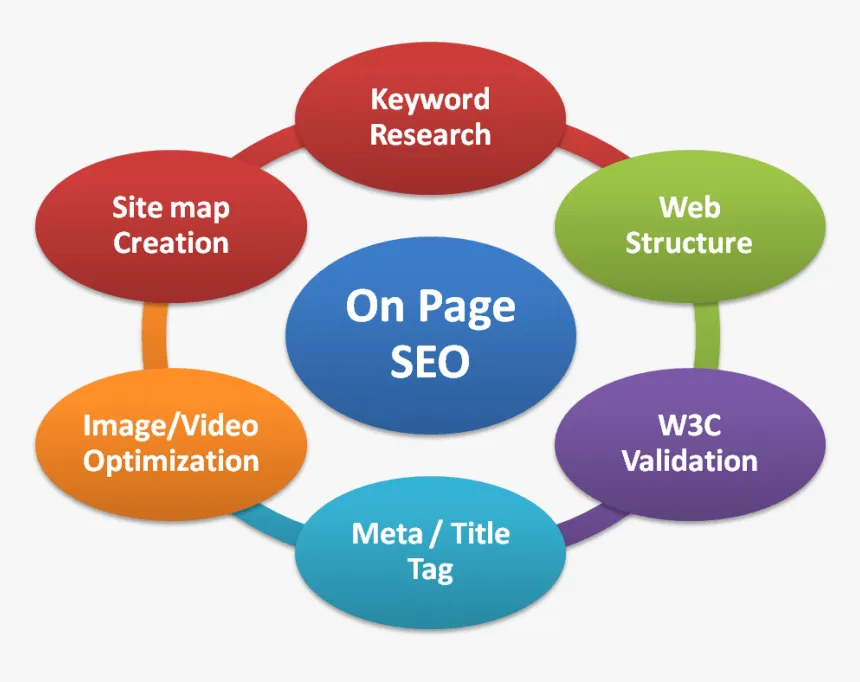
How to Optimize On-Page SEO of Your Site in 2026?
To master On-Page SEO today, you must optimize 3 distinct layers:
- The Content Layer: Providing high “Information Gain” that AI cannot easily replicate.
- The Structural Layer: Using Semantic HTML and Headers to “chunk” data for AI Overviews.
- The Technical Layer: Fine-tuning performance metrics like INP to ensure the page is functional, not just visible.
Ultimately, On-Page SEO is the art of making your page the most “digestible” and authoritative source for a specific concept in the digital ecosystem.
Below, I have outlined some implementation practices that will undoubtedly help you optimize On-Page SEO in accordance with the evolving Search Engine Optimization landscape of 2026.
1. The Core Philosophy: Entity-Based On-Page SEO
In 2026, search engines don’t just see words. They see Entities. An entity is a uniquely identifiable object or concept. Instead of targeting the keyword “on-page SEO,” Google is looking for the entity of “Search Engine Optimization” and its relationship to other entities like “SGE,” “Core Web Vitals,” and “Structured Data.”
From Keywords to Semantic Concepts
To educate your audience effectively, you must move beyond repetition. Your on-page strategy should focus on Semantic Density. It means including “LSI 2.0” terms or LSI keywords. These are the words that logically must exist if you are truly an expert on a topic.
- The Example: If you are writing about “Healthy Diets,” your page must also contextually mention “Macronutrients,” “Metabolic Rate,” and “Whole Foods.” If these related entities are missing, AI crawlers will flag your content as “thin” or “surface-level.”
2. Master the 2026 Title Tag and Meta Architecture
Your title tag remains the most important on-page element, but its role has shifted. It is no longer just about the click. It is about Intent Confirmation.
The “Hook and Hold” Title Formula
In 2026, search results are often summarized by AI. If your title is vague, the AI will rewrite it for you (and not always in a way you like). You must use the Primary Keyword + Specific Benefit + Urgency formula.
- Example: Instead of “On-Page SEO Guide,” use “On-Page SEO in 2026: Key Tactics to Outrank AI Overviews.”
- Length: Keep it between 50-60 characters. Anything longer gets truncated, and in a mobile-first world, a cut-off title looks unprofessional and untrustworthy.
Meta Descriptions as “Prompt Engineering”
You now need to consider your meta description as a prompt for the user. While not a direct ranking factor, it heavily influences Click-Through Rate (CTR), which is a massive signal in 2026.
Use active voice, such as “Learn how to optimize your site for 2026. Master INP, Schema, and SGE in this complete technical breakdown.”
3. The New Header Hierarchy: Signposting for Humans and Bots
Headers (H1-H6) are the skeleton of your content structure. In 2026, they serve a dual purpose:
- They help users scan
- They help AI models “chunk” your data for snippets.
The H1: Your Singular Mission
Every page must have exactly one H1. It should be the most prominent text on the page and clearly state the page’s purpose. Avoid clever puns; stick to clarity. Also, Google is considering the primary intent of the user while listing the articles at the top of the SERP.
For Example: You search for “Remote Work Setup,” and you will eventually see the search results with the title “Home Office Work Setup.”
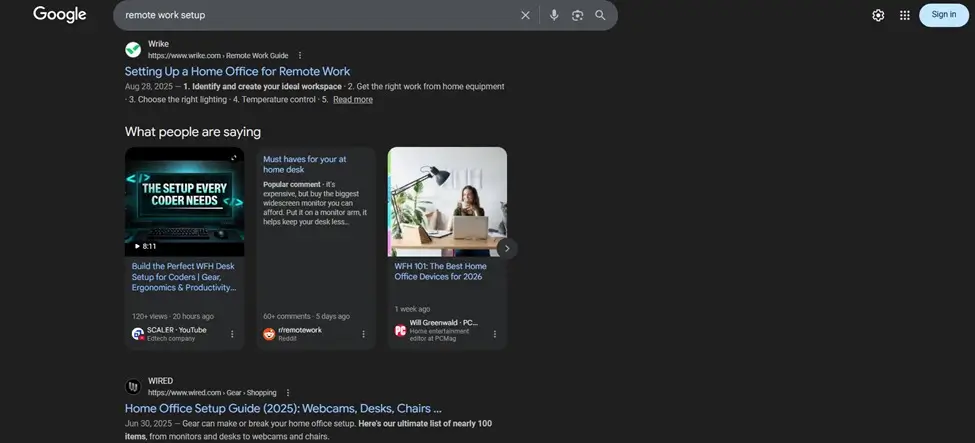
This is not a coincidence. Google knows that the person who is working remotely is primarily working from home and looking for a “home-office setup” or “work from home setup” guide.
So, instead of showcasing the articles that target the main keyword in the title, Google has listed the articles that hit the primary search intent of the users. It is one of the major shifts I have noticed in the 2026 SERP evolution.
The H2-H3 “Answer Engine” Strategy
Modern headers should be phrased as questions or direct statements that mirror search queries.
- Tactical Tip: Use your H2s to address the “People Also Ask” questions. If the H2 is “How do I optimize for SGE?”, the paragraph immediately following it should provide a concise, 40-word direct answer. This increases your chances of being featured in the AI Overview.
4. Content Quality: The E-E-A-T Framework
Experience, Expertise, Authoritativeness, and Trustworthiness (E-E-A-T) are the pillars of the 2026 helpful content algorithm. So, you need to master EEAT to break the shackles. Otherwise, you will be down and dusted.
Prioritize “Information Gain”
Search engines now penalize “copycat” content. If your article says the same thing as the top five results, you have zero Information Gain. To rank, you must add something new:
- Original Data: Conduct a survey or a small experiment.
- Contrarian Insight: Challenge a common industry myth.
- Personal Case Studies: Show the “behind-the-scenes” of a project.
The Death of “Fluff”
In 2026, AI can write “fluff” better than any human. To differentiate your content, get to the point immediately. Use the Inverted Pyramid style: give the most important information in the first two paragraphs, then expand into the details.
5. Technical On-Page Elements: Speed, INP, and Accessibility
You cannot separate on-page SEO from technical performance. If the page is slow, the “on-page” doesn’t matter because the user is gone.
Interaction to Next Paint (INP)
As of 2024-2025, INP became a core ranking factor, and by 2026, it is the gold standard. INP measures the latency of every user interaction.
- The Goal: Under 200ms.
- How to Optimize: Reduce heavy third-party scripts (like unnecessary tracking pixels) and optimize your Main Thread work. Every button click on your page must feel instantaneous.
Image SEO: The Visual Search Era
Images are no longer just “decor.” With Google Lens and visual AI search, your images are entry points to your site. That’s why Image SEO is now more crucial than ever.
- File Formats: Use AVIF or WebP. They offer superior compression without losing quality. I am personally biased toward using WebP.
- Contextual Alt Text: Don’t follow keyword stuffing tactics. Describe the image for a visually impaired person while including the entity.
- Bad: “SEO chart.”
- Good: “A line graph showing the 2026 correlation between INP scores and organic traffic growth.”
- Image File Name: The file name of your image also impacts Image SEO. You should make sure that it adds some value to your content and should not be like a generic name.
6. Advanced Schema Markup: Speaking “Machine”
If HTML is the body of your page, Schema is the brain. It’s structured data that tells search engines exactly what they are looking at.
Must-Have Schema for 2026:
- Article Schema: Tells the bot this is a long-form piece of content.
- FAQ Schema: Still vital for capturing real estate on the SERP (Search Engine Results Page).
- Author Schema: This is huge for E-E-A-T. It links the content to the author’s “Knowledge Graph” profile, which proves a human expert wrote it.
- Speakable Schema: Helps AI voice assistants (like Siri or Gemini Live) read your content aloud to users.
7. Internal Linking: The Site’s Nervous System
Internal links distribute “link juice” (authority) throughout your site. In 2026, the focus is on Contextual Relevance.
The Silo Method
Group related content into silos. If you have a section on “Technical SEO,” all pages in that section should link to each other and up to a “Pillar Page.” It tells search engines that you have deep, organized knowledge on a specific topic.
Descriptive Anchor Text
Never use “click here.” Your anchor text should be the keyword or entity of the target page. For example: “Learn more about [advanced schema implementation] in our technical guide.”
Check Broken Links
Also, you should check broken links in your article to make sure the user lands on the page that is live. It will build trust and also signals Google that your site is completely organized.
8. The Strategic Use of External Links
External linking is the practice of hyperlinking to high-authority, third-party domains to validate your claims and provide users with additional resources.
In the 2026 search ecosystem, external links serve as “Trust Signals” that verify your content’s E-E-A-T by connecting your page to the global Knowledge Graph.
Beyond “Citations”: The 2026 Linking Strategy
In the age of AI-generated misinformation, external links are the “receipts” for your expertise. To optimize your external links for modern search, you should focus on three core pillars:
- Link to “Seed Sites”: Google and other LLMs prioritize content that connects to “Seed Sites”. These are the trusted, foundational sources like major news outlets, government databases (.gov), or academic journals (.edu). It confirms your content isn’t “hallucinating” facts.
- The Information Gain Loop: Don’t just link to the homepages of your competitors. Link to specific white papers, raw data sets, or contrarian viewpoints. It shows Google and AI that your content is part of a deep, nuanced research process.
- Link Relevance > Domain Authority: A link to a niche, highly relevant, and helpful industry blog is now often more valuable than a generic link to a high-DA site like Wikipedia. Contextual alignment is the primary metric for 2026.
9. Mobile-First Interaction Design
Since 2025, Google has moved to 100% mobile-first indexing. If your mobile page has less content than your desktop page, you will be penalized.
- Readability: Use a minimum of 16px or 18px font size.
- Tap Targets: Ensure buttons are not too close together. “Fat-finger” errors lead to high bounce rates.
- Interstitials: Avoid intrusive pop-ups that cover the main content on mobile. These are a direct ranking demotion factor in 2026.
10. Monitor Performance with Modern Tools
On-page SEO is not a one-time event. It is a loop of Optimization > Measurement > Iteration.
The Feedback Loop
- Google Search Console (GSC): Watch your “Core Web Vitals” report weekly.
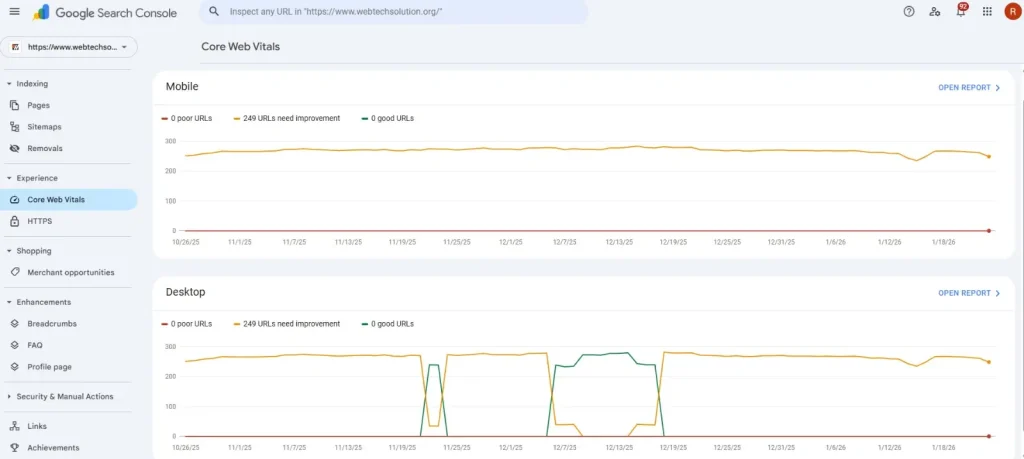
- Google Analytics: Determine the dwell time of users on your content to find pages with higher bounce rates.
- Heatmaps: Use tools like Hotjar or Clarity to see where users stop scrolling. If they drop off at a specific H2, that section needs better visuals or clearer writing.
- Log File Analysis: See how often AI bots (like GPTBot or Google-InspectionTool) are crawling your pages. Frequent crawls mean the AI finds your content valuable.
How to Implement New On-Page SEO Strategies Today? A Punchy Starting Tactic from WebTech Solutions
So now you know how the On-Page SEO landscape has shifted in 2026. So, it’s time to start auditing your website and content.
I know you cannot do everything at once. So, I am giving you a one-punchy starting tactic that can help you build the momentum to optimize your site per the 2026 model.
- Audit your H2s: Are they questions people are actually asking?
- Check your Speed: Is your INP under 200ms?
- Inject Experience: Can you add a real-life example to every section?
The race for the top spot in 2026 is no longer about who has the most keywords. It is about who has the most authority.
Final Thoughts on On-Page SEO: The Human-Centric Future
As we navigate 2026, the secret to On-Page SEO is simple yet difficult: Be the best possible answer for the user.
Search engines are now smart enough to detect when you are writing for an algorithm. They want to see depth, original experience, and technical perfection. When you focus on Entity-based content, master INP, and use Advanced Schema, you aren’t just optimizing for a search engine. You are building a digital asset that will stand the test of time.
Need custom app with amazing features?
Get a Quote