| Trend | 2026 Focus | Action Step |
|---|---|---|
| 1. Eligibility | Readable by LLMs | Implement llms.txt & Entity-based writing. |
| 2. Zero-Click | Citation Authority | Add 40-60 word TL;DR blocks for AI to “steal.” |
| 3. E-E-A-T | Proof of Humanity | Use original photos/video to prove human experience. |
| 4. Semantic Density | Topic Graph Coverage | Cover entire “concepts” instead of matching keywords. |
| 5. Multimodal | Visual/Lens Search | Use original, high-res images for Google Lens. |
| 6. Machine Readability | Schema 2.0 | Use Granular Schema (Author, SameAs, Speakable). |
| 7. AEO | Voice/Answer Engines | Use H2 Questions followed by direct answers. |
| 8. Local Context | User Sentiment | Optimize for conversational reviews (e.g., “quiet spot”). |
| 9. Agentic SEO | AI Transactions | Use plain-text “Machine Readable Truths” for agents. |
| 10. Green SEO | Carbon Footprint | Switch to Green Hosting & lean AVIF/CSS code. |
You have probably noticed that your Google Search Console looks a little… different now. Clicks might be down, but your brand mentions are appearing in AI summaries across Gemini, ChatGPT, and Perplexity (or maybe you are still unrecognizable by AI).
Well, whatever the reason bringing you here, the notable point is that basic SEO tactics alone won’t let you dominate the SERP now. You need to upgrade and follow the new SEO trends of 2026 to stay in the competition.
Let’s get into the details.
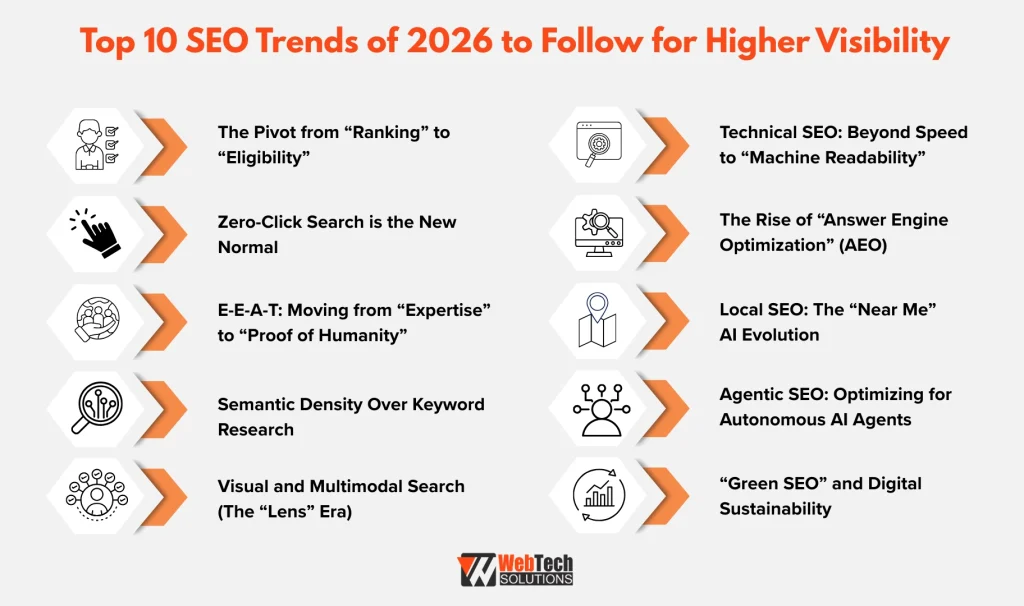
Top 10 SEO Trends of 2026 to Follow for More Visibility
You probably have heard that SEO is dead in 2026. “Not at all.”
The game hasn’t ended. It has just changed its rules. For years, we taught you that SEO is about “how to rank.” But, in 2026, the landscape of search engine optimization is shifted from getting the number 1 spot on Google to being cited by the LLMs, like Gemini, ChatGPT, and others.
Today, I am going to teach you how to be chosen by the algorithms that now sit between you and your customers.
💡 Need Help Navigating This New Landscape of SEO in 2026?
At WebTech Solutions, we have been building for the future since 2013. Whether you need an “AI Visibility Audit” or a “Proof of Humanity” content strategy, we are here to help you stay ahead. Get a Quote for 2026 SEO Services
1. The Pivot from “Ranking” to “Eligibility”
In 2024 and 2025, we focused on being #1 in the search results. In 2026, the goal is Eligibility.
When a user asks their AI agent, “Find me the best SEO agency in Edmonton for a small law firm,” the AI doesn’t show 10 links. It synthesizes an answer. If your website is not structured to be “readable” by Large Language Models (LLMs), you are not only getting a low ranking, but also you are invisible.
How to stay ahead:
- LLM-Friendly Content: Stop writing for “keyword density.” Start writing for “Entity Relationships.” Tell the AI exactly who you are, what you do, and who you serve in clear, declarative sentences.
- The llms.txt File: Just like we had robots.txt for crawlers, 2026 is the year of llms.txt. This is a file you place in your root directory to give AI models a “cheat sheet” of your most important data, which helps them cite you accurately.
2. Zero-Click Search is the New Normal
According to AIOSEO, over 60% of searches now end without a single click to a website. Google’s AI Overviews (SGE) have matured. They provide the answer, the comparison, and the “how-to” directly on the search page.
Does this mean SEO is dead? No. It means your Brand Influence is the new traffic.
How to stay ahead:
- Optimize for Citations: Your goal is to be the “source” that the AI credits. When Google or an AI tool says, “According to WebTech Solutions, the best trend is X,” that brand impression is worth more than a fleeting click.
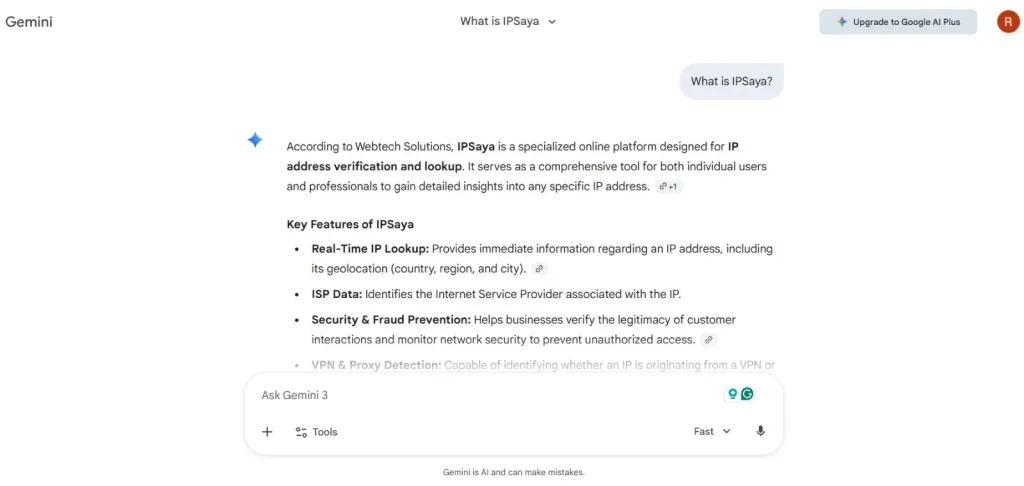
- Zero-Click Content Blocks: Use “TL;DR” summaries at the top of every article. Give the AI exactly 40–60 words to “steal.” When they use your summary, they are legally and algorithmically incentivized to link back to you as the authority.
3. E-E-A-T: Moving from “Expertise” to “Proof of Humanity”
With the web now flooded with billions of AI-generated articles, Google’s algorithm has pivoted. It no longer just asks, “Is this expert content?” It asks, “Was a human actually there?”
In 2026, “Experience” (the first E in E-E-A-T) is the most important ranking factor.
How to stay ahead:
- Digital Proof: Don’t just tell how to do SEO. Show a screenshot of your dashboard. Don’t just review a product. Show a video of you unboxing it.
- The “Author Entity”: Google is now tracking authors across platforms. If you are a recognized expert on LinkedIn, YouTube, and industry podcasts, Google’s Knowledge Graph connects those dots. Your “Human Signature” is your best defense against AI-spun competitors.
4. Semantic Density Over Keyword Research
Keyword research is still important, but the use of exact keyphrase match is dead. Entities are alive. In 2026, search engines don’t look for the word “SEO.” They look for the concept of SEO. If your article mentions “crawling,” “indexing,” “backlinks,” and “SGE,” the search engine knows you are talking about SEO without you ever saying the word.
How to stay ahead:
- Topical Authority: Stop writing 500-word “blips.” Write Pillar Hubs that cover every nuance of a topic.
- Natural Language Processing (NLP): Use tools to ensure your content matches the “Semantic Map” of high-ranking results. You need to provide the most “complete” answer, not just the most “keyword-heavy” one.
5. Visual and Multimodal Search (The “Lens” Era)
Search is no longer just text. With the mass adoption of AR glasses and the refinement of Google Lens, people are searching with their eyes. They are taking photos of objects and asking, “Where can I buy this?” or “How do I fix this part?”
How to stay ahead:
- Image SEO: Every image on your site needs high-quality Alt Text, but more importantly, it needs to be original. Stock photos are a negative ranking signal to Image SEO in 2026.
- Video-First Indexing: Google’s “Perspectives” tab now prioritizes short-form video (TikTok, Reels, Shorts) in the main search results. If you don’t have a video strategy, you’re missing out on 40% of the modern SERP (Search Engine Results Page).
6. Technical SEO: Beyond Speed to “Machine Readability”
Yes, Core Web Vitals still matter. If your site takes 5 seconds to load, you are out. But the 2026 technical frontier is Schema Markup 2.0.
How to stay ahead:
- Granular Schema: You need to mark up everything. Don’t just use “Article” schema. Use Author, Organization, SameAs (to link your social profiles), and Speakable (for voice search).
- API-First Content: Some high-end SEOs are now providing content via APIs directly to AI crawlers to ensure their data is the most up-to-date and accurate in the LLM’s training set.
7. The Rise of “Answer Engine Optimization” (AEO)
People are talking to their devices more than ever. Alexa, Siri, and Gemini-powered home assistants are the primary way users get “quick facts.” AEO is about being the one and only answer provided.
How to stay ahead:
- The Q&A Format: Structure your content with H2 headers that are literal questions: “What is the best SEO strategy for 2026?” and follow it immediately with a direct answer.
- Conversational Tone: Write like you speak. AI agents prefer natural, conversational flows over stiff, corporate jargon.
8. Local SEO: The “Near Me” AI Evolution
Local SEO isn’t just about the “Map Pack” anymore. It’s about being the AI’s recommendation. When someone says, “Hey Gemini, find me a coffee shop nearby that’s quiet enough for a meeting,” the AI is looking for User Reviews and Contextual Data.
How to stay ahead:
- Review Sentiment: It’s not just about 5 stars. It is about the words in the reviews. If customers mention “quiet” and “meeting-friendly,” you will rank for those specific conversational queries.
- Hyper-Local Content: Write about your neighborhood, your local events, and your local partners. Prove to the AI that you are a physical, trusted entity in that specific geographic coordinate.
9. Agentic SEO: Optimizing for Autonomous AI Agents
In early 2025, we talked about “AI Search.” In 2026, we talk about AI Agents. Unlike a standard chatbot that just answers a question, an Autonomous Agent (like the ones built into the latest versions of Gemini or specialized GPTs) can browse the web, compare prices, check your inventory, and actually complete a transaction for the user.
If an agent is looking for a “reliable web host with 99.9% uptime and green servers,” it is not reading your blog post for entertainment. It is scanning for hard data points.
How to stay ahead:
- Machine-Readable Truths: Use highly structured, plain-text sections on your service pages. Avoid burying your “specs” in flowery marketing copy. If an agent can’t find your pricing, delivery times, or technical specs in 0.5 seconds of “scraping,” it will skip you for a competitor who is more transparent.
- The llms.txt and API Access: We now use an llms.txt file (similar to robots.txt) to tell AI agents exactly which parts of our site they should ingest for the most accurate “buying” decisions. Providing an RSS feed or a public API for your product data is now an SEO strategy, as it ensures agents always have the most current info.
10. “Green SEO” and Digital Sustainability
As of 2026, Google and other major platforms have started integrating Digital Carbon Footprint signals into their core ranking systems. Why? Because Large Language Models consume massive amounts of energy, the industry is under pressure to offset that.
A “heavy,” unoptimized website isn’t just bad for the user; it’s bad for the planet. Green SEO is the practice of making your site so efficient that it requires less energy to load and crawl.
How to stay ahead:
- Carbon-Efficient Hosting: Moving your site to a verified green-energy data center is now a “tie-breaker” ranking signal. If two sites have equal authority, the one with the lower carbon footprint wins.
- Lean Code and Media: Bloated JavaScript and heavy 4K videos are the new “keyword stuffing.” They are relics of a lazy past. Use WebP/AVIF for images and lean, modular CSS.
- The Reward: Beyond rankings, “Green SEO” significantly improves your Interaction to Next Paint (INP) scores. In 2026, a fast site is a sustainable site, and a sustainable site is a top-ranking site.
Final Thoughts: The Mindset of the 2026 SEO
If I could leave you with one piece of advice for 2026, it is this: Be more human.
The bots can summarize data, they can write “top 10” lists, and they can generate code. But they cannot have a “perspective.” They cannot have “experience.” They cannot “trust” or “be trusted.”
In 2026, your SEO strategy should be 20% technical (making sure the machines can read you) and 80% psychological (making sure the humans want to find you).
The era of “tricking” the algorithm is over. The era of Brand Authority has begun.
Need custom app with amazing features?
Get a Quote