
Remote work strips away hallway cues, and misunderstandings stall deadlines. That’s why employers now lean on personality assessments. 80% of the Fortune 500 companies use at least one test beyond hiring to shape teamwork and leadership, according to Leaders. The right questionnaire gives every team a shared language for strengths and stress triggers, turning guesswork into faster decisions.
TeamDynamics, the team personality assessment platform, sees that disconnect up close; its 2025 State of the Team report finds that nine in ten professionals have at least one core working preference that clashes with their team’s norms around communicating, deciding, or executing. Unless a group surfaces those gaps early, hidden friction slows every sprint.
In this guide, we compare five personality test tools so you can pick the best fit for your budget, timeline, and stakes.
How to Choose the Right Personality Test?
Use outcome, resources and scope as quick filters to choose the right personality test for your work team
Start with three quick yes-or-no checks:
- Outcome: Do you want a fast pulse check on daily collaboration, or a deeper talent strategy (succession planning, culture shift)?
- If speed matters, choose a lightweight survey.
- If strategy matters, choose a tool with published research and optional facilitation.
- Resources: Can every teammate spare about 15 minutes and $40?
- If yes, self-serve tools work.
- If not, set aside budget and meeting time for premium, consultant-led diagnostics.
- Scope: Do you need insight at the individual level, the team level, or both?
- Some assessments start with personal preferences and roll up.
- Others examine group dynamics first, then map findings back to each person.
Answering these three questions narrows the field to a quick survey like TeamDynamics, a communication aid like DiSC, a familiar entry point like MBTI, a strengths lens like CliftonStrengths, or an executive-grade diagnostic like Hogan. Keep this shortlist nearby as you review each tool.
5 Best Personality Tests for Work Teams
1. TeamDynamics: the fast track to team insight
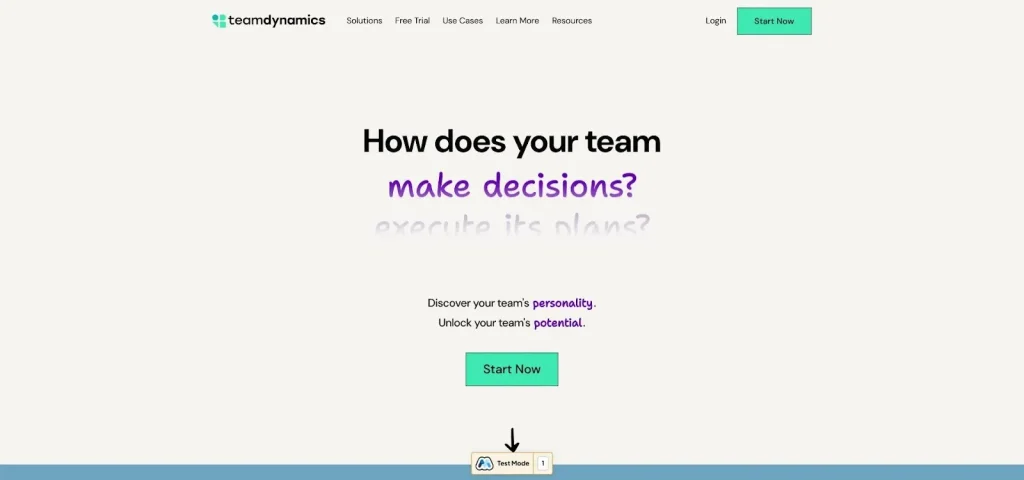
A 10-minute online survey is all TeamDynamics needs to map how your group communicates, processes, decides, and gets work done. Instead of tagging people with letters or colors, the assessment reviews four behavioral dimensions and sorts the whole group into one of 16 team types, giving you a single portrait rather than a set of solo profiles.
The interactive report arrives right away. It highlights where the team already excels and where friction slows delivery. Example tips include silent brainstorming when meetings get noisy or time-boxed debate when choices stall, and every suggestion uses plain language, so a coach isn’t required.
Licenses run $29–$39 per person for teams of up to 20 with no facilitator fee or subscription. Share a link, watch results appear in real time, and move from insight to action before the next sprint.
If speed and practicality top your list, start with TeamDynamics. It turns everyday work habits into data while that data is still fresh enough to act on.
2. DiSC: cutting miscommunication at the source.
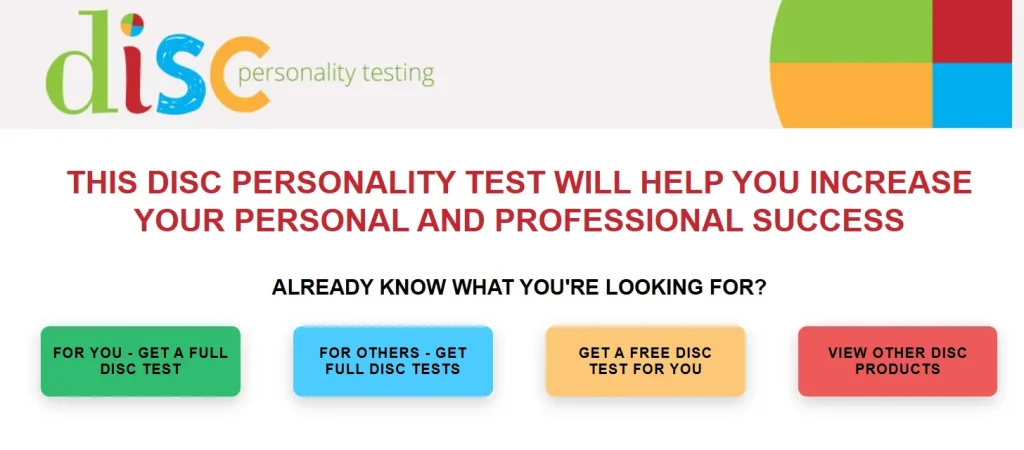
Missed deadlines often trace back to the people’s side of work, like short fuses, vague briefs, and unspoken assumptions. DiSC addresses those gaps by plotting each teammate on four behavioral scales: Dominance, Influence, Steadiness, and Conscientiousness.
The model sticks because it’s simple. After one workshop, most people remember their main letter, so phrases such as “I’m a high C, let me document the process” become everyday shorthand.
The newer DiSC on the Catalyst portal increases its value for hybrid crews. Click a colleague’s name and you’ll see tailored tips on how to email, meet, or negotiate with them, putting guidance right where friction starts.
Pricing begins at $90 per profile (volume discounts drop to about $74) with no facilitator required, though many teams invite an HR lead to run the debrief, according to the Everything DiSC Workplace profile. The assessment takes about 20 minutes online, and results appear instantly.
If your inbox is crowded with reply-all threads or meetings keep spiraling, DiSC offers a fast reset. In a single afternoon teammates can name their own style, respect others’ pacing, and leave with a shared playbook to stop tension before it derails work.
3. MBTI: the gateway to self-awareness.
The Myers-Briggs Type Indicator (MBTI) is instantly recognizable; most professionals have seen their four-letter code at a conference or on LinkedIn before they ever take the test. That familiarity lowers resistance and sparks quick “aha” moments.
With MBTI online Teams, each teammate completes the official questionnaire, and a shared dashboard places every result on the classic 16-type grid. Viewing the team’s letters side by side reframes quirks as predictable preferences. For example, an “ENFP” marketer isn’t scattered, she’s wired for options, while an “ISTJ” developer isn’t rigid, he thrives on structure.
Because the language stays uniformly positive, people open up fast, and the talk shifts from “why are you like this?” to “how do we balance our styles?”
The self-guided package costs $99.95 per participant for teams of three or more and includes individual reports, a team portal, and four micro-learning modules. It’s more costly than free look-alikes, but you get the official instrument plus e-learning you can run during remote stand-ups.
Use MBTI when a new group needs an easy icebreaker backed by a familiar framework. Just remember its limits: many psychologists debate its predictive power, so treat it as a conversation starter, not a hiring filter. Done right, MBTI opens the door to deeper tools that follow.
4. CliftonStrengths: turning talent into daily output.
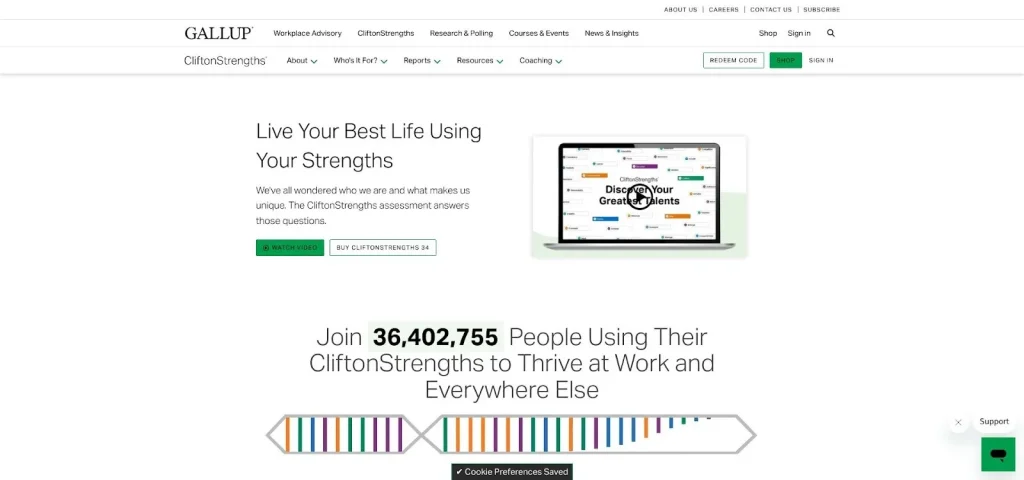
Where other tools spotlight differences, CliftonStrengths highlights each person’s natural energy. In about 30 minutes online, the Gallup-built assessment surfaces your top five themes out of 34 and shows how to turn them into performance gains.
According to Gallup’s multi-year studies, teams that focus on strengths every day post 12.5 percent higher productivity and 8.9% higher profitability.
The report is straightforward: a color-coded PDF that reads like a coaching script rather than a personality grid. A salesperson high in Realtor and Communication can run client calls, while an analyst strong in Analytical and Deliberative becomes the resident risk spotter.
Managers can open the team grid and see at a glance where talent clusters or gaps appear. If no one scores high in Harmony, schedule structured conflict checks; if several teammates rank in Strategic, channel that thinking into roadmap sessions.
Pricing starts at $24.99 per user for the Top 5 report and $59.99 for the full 34-theme profile. For remote squads, the digital dashboard and ready-made workshop guides go live faster than ordering lunch.
Reach for CliftonStrengths when engagement drags or roles blur. It moves the conversation from “Who owns this?” to “Whose strengths light this up?” That single shift often speeds delivery.
5. Hogan: executive-grade precision for high-stakes teams.
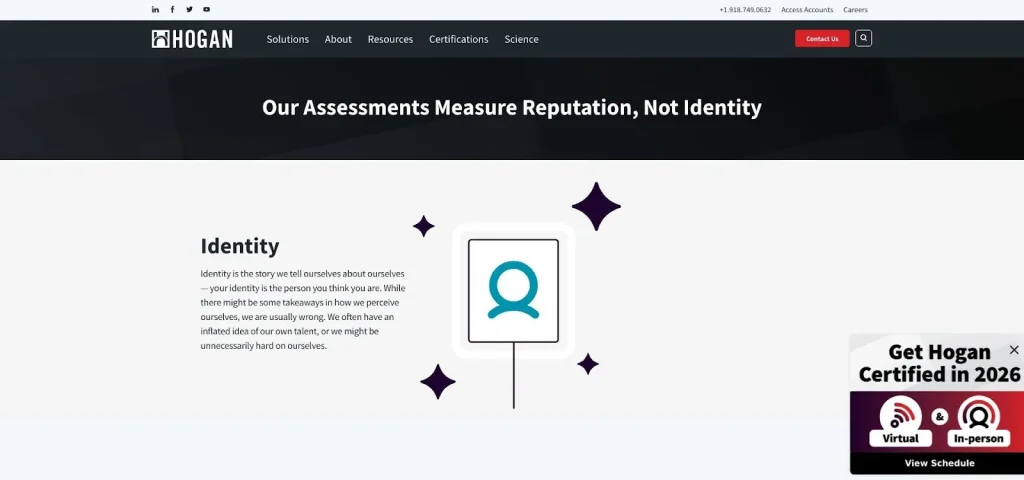
When the margin for error is zero, whether a product launch worth billions or patient outcomes on the line, surface-level insights fall short. Hogan adds clinical depth through three linked inventories: the HPI captures daily style, the HDS flags derailers under stress, and the MVPI reveals core values.
Each teammate finishes the trio online, and the combined report reads like an X-ray of group culture, showing where ambition spikes, caution dips, or values clash. It’s far better to surface those patterns in a workshop than in the boardroom.
According to Hogan Assessments, more than 75 percent of Fortune 500 companies rely on certified practitioners, and four decades of peer-reviewed studies back its predictive power.
Depth does cost: most off-the-shelf Hogan reports run $200–$350 per participant, with facilitator fees on top. For executive teams, that investment often prevents seven-figure misfires caused by unchecked overconfidence or silent dissent.
Reach for Hogan when you need more than harmony. It diagnoses culture risk, guides succession bets, and equips leaders with the self-awareness to steer through crises without veering off course.
How to Vet any New Assessment?
Even trusted names were once new. Before you sign a purchase order, put every assessment through five quick checks:
- Scientific backbone. Look for published validity and reliability studies or citations in bodies such as SIOP’s Testing Standards. If a vendor offers only proprietary data, keep searching.
- Team-level output. Scores help, yet the real value lies in a report that rolls findings up for the whole group so the team can act, as shown in an in-depth evaluation of team-assessment software.
- Actionable guidance. A credible test ends with plain-language recommendations rather than adjectives, making it useful from intern to executive.
- Remote-ready delivery. The tool should open in any modern browser, support multiple time zones, and avoid paper forms or on-site proctoring.
- Transparent pricing. Confirm per-seat cost, facilitator fees, and renewal terms upfront. Hidden charges erode trust faster than a bad meeting.
Quick-scan Comparison
| If you have 30 seconds between meetings, this grid shows how the five assessments stack up on factors teams ask about most. | 🟢 strong | 🟡 watch-out | 🔶 depends on facilitation |
| Criteria | TeamDynamics | DiSC | MBTI | CliftonStrengths | Hogan |
| Scientific validity | 🟢 Evidence-based team model | 🟡 Reliable but older theory | 🟡 Popular, mixed rigor | 🟢 Gallup research backbone | 🟢 Peer-reviewed and predictive |
| Team-level report | 🟢 Built-in | 🟢 Catalyst dashboard | 🟡 Grid view only | 🟢 Strengths grid | 🟢 Deep team analytics |
| Actionable tips | 🟢 Concrete next steps | 🟢 Style-by-style advice | 🟡 High-level guidance | 🟢 Role alignment cues | 🟢 Risk mitigation plans |
| Remote ease | 🟢 Self-serve, 10 min | 🟢 Browser-based, 20 min | 🟢 Fully online | 🟢 Digital dashboards | 🔶 Online delivery, guided debrief |
| Cost per person* | $29–$39 | $74–$90 | $99.95 | $24.99–$59.99 | $200–$350 |
| Best for | Fast workflow tune-ups | Fixing miscommunication | Warm-up self-awareness | Boosting engagement | High-stakes leadership |
*Prices are United States dollars list rates for small-team licenses; volume discounts may apply.
Use the column that matches your top priority—validity, cost, or depth—then scan across to see which option stays green (or orange) for your situation.
Why These Personality Tests Drive Workplace Growth
Personality tests aren’t about labels—they’re about leverage. When teams understand how they communicate, decide, and execute, friction turns into flow. The best assessment is the one that fits today’s challenge, not the one with the flashiest framework.
If you need fast clarity on how a team actually works, TeamDynamics delivers immediate, team-level insight you can act on this week. If miscommunication dominates daily work, DiSC gives teams a shared shorthand to course-correct in real time. MBTI lowers the barrier to self-awareness, CliftonStrengths channels talent into output, and Hogan brings rigor when leadership risk is high.
Whatever tool you choose, the real ROI comes from what happens next. Debrief quickly, translate insight into one or two new team habits, and revisit as the team evolves. Assessments work best not as a one-time event, but as part of an ongoing conversation about how people do their best work together.