Disconnected marketing tools lead professionals toward budget wastage and missing opportunities, which is why you have to build a Martech Stack for yourself. A unified Martech stack is essential for scalable and predictable growth. This helps you to focus on the right tools, which are connected, strategic, and aligned with your goals.
In this blog post, you will learn what a Martech stack is and how you can build one. This will include a step-by-step guide, best practices to maintain your stack and core categories every modern stack requires.
What is a Martech Stack?
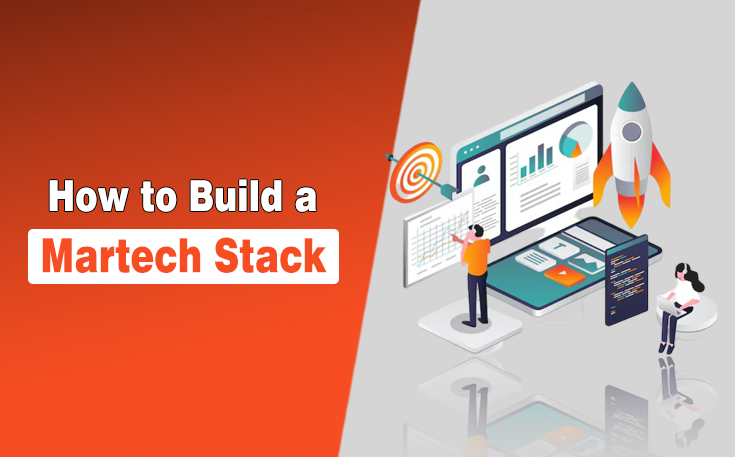
A Martech stack (short for marketing technology stack) is the integrated set of software, platforms, and tools that marketers rely on to manage campaigns, track performance, and deliver personalized customer experiences.
CDP and CRM are the major elements in these stacks. They are used to store first-party data, automation engines that organize journeys, and analytics platforms to measure performance.
The main aim is to remove data silos and make use of real-time and context-sensitive personalization. In this modern age, successful strategies are built by determining how conveniently tools cooperate with each other to transfer the data between capture and activation.

How to Build a Martech Stack – Step-by-Step Guide
Now I will give you a step-by-step guide that helps you build a Martech Stack, tailoring your requirements:
1. Define Strategic Objectives and Customer Journeys
Define your important business objectives, such as an increase in lead generation or error reduction, before selecting software. Determine your customer journey to identify the pain point where technology can help fill a gap.
Choose central use cases to drive the purpose of each tool. And you have to be sure your stack is explicitly aligned to achieve measurable outcomes and business strategies.
2. Audit Existing Tools and Capabilities
Most of the companies overuse the marketing tools and fail to realize their full potential. Conduct an audit and track the cost, usage, and integration of tools available in the market that you require. Eliminate duplication or old non-functional software.
This simplifies your stack, reduces expenses, and enables investment in more modern tools that can better serve business objectives, driven by AI.
3. Establish a Unified Data Foundation
An effective Martech stack is based on available and authentic data. Make one customer data platform or data warehouse to save all of the repositories.
This leads to centralizing customer identities, privacy-by-design, and data flow. In the absence of a single layer of data, marketing initiatives are divided, and artificial intelligence no longer works.
4. Prioritize Seamless Integration and Connectivity
Select marketing tools that work perfectly with your stack. Put emphasis on software that has excellent APIs and native connectors. This facilitates the easy replacement of integrations with the change of technology.
Avoid closed systems. Interoperability helps your insights be immediately triggered to act across channels and form the basis of an efficient, responsive marketing engine.
5. Evaluate AI-Native Functionality and Automation
Marketing tools have to go beyond automation, and this will require making independent decisions. Select the vendors who have good AI features, such as generative and predictive.
Use tools that inflate the content and surface forms automatically, so your team does not concentrate on strategy, creative output, and creating quantifiable business value.
Core Categories Every Modern Martech Stack Needs
In 2026, a well-functioning Martech layer is an ecosystem that gets built into four important layers:
1. Data and Audience Management
This is the system of record that unifies fragmented customer information into a single source of truth.
- Customer Relationship Management (CRM): The database of contact information of customers and sales, such as Salesforce and HubSpot.
- Customer Data Platform (CDP): CDPs enable you to centralize first-party data and achieve real-time identity resolution, such as Twilio Segment and mParticle.
- Data Warehouse and Integration: Housing of bulk data and technology is necessary to guarantee that all the technologies are communicating with one another, such as Snowflake and Zapier.
2. Content and Experience
These tools power the digital properties where customers interact with your brand.
- Content Management System (CMS): Drives web pages, blogs, and landing pages such as WordPress and Webflow.
- Digital Asset Management (DAM): A type of intelligent content hub to organize and deliver content on-brand, such as Canto and Bynder.
- Social Media Management: Plan, schedule, and listen to systems on the social platform such as Sprout Social and Hootsuite.
3. Orchestration and Automation
This layer automates repetitive tasks and triggers real-time, cross-channel customer journeys.
- Marketing Automation Platform (MAP): It operates a sophisticated lifecycle of leads, lead scoring, and nurturing of leads, such as Marketo Engage and Braze.
- AI Agents and Content Production: It autonomously creates, optimizes, and personalizes creative content in large quantities, such as Jasper.
- Advertising Technology (AdTech): This includes programmatic buying, PPC, paid social campaign program management tools such as Google Ads and Meta Ads Manager.
4. Analytics and Insights
This layer turns activity into decisions by quantifying channel contribution and guiding budget moves.
- Web and Product analytics: These are used to monitor behavior and conversion path, such as Google Analytics 4, Mixpanel.
- Attribution and Performance: Experienced true lift using multi-touch attribution (MTA) or using Marketing Mix Modeling (MMM), such as Keen and RedTrack.
- Privacy and Governance: This works for consent management, data compliance, and automated workflows, such as Ketch and OneTrust.
Best Practices for Building and Maintaining Your Stack
Here are the best practices that you should work on for building and maintaining your Martech stack:
1. Adopt a “Privacy-First” Data Infrastructure
Keeping a martech stack in 2026 implies a focus on privacy and compliance. Use a Customer Data Platform to centralize the data and have it as the truth of consent and identity.
Make sure that all tools respect real-time opt-out. Develop trust and maintain high data hygiene and data security by using first- and zero-party data, rather than third-party cookies.
2. Prioritize Composable and AI-Ready Architectures
Effective Martech stacks are based on composable, inter-modular systems rather than strict suites. This allows you to replace new AI marketing tools without interrupting workflow. You should always pick components that have open APIs and native connectors.
This will help them to flow easily with data without making your stack rigid and inflexible to the dynamic technology requirements.
3. Institutionalize Audits and Talent Enablement
Martech stack development is only a beginning, and the maintenance with focus and discipline is the key to success. Check your stack periodically to identify tools that have not been utilized and eliminate them.
Spend on team improvement and playbooks to ensure your staff uses your technology to the fullest extent. This is to make complicated systems a profit generator for your business.
Partnering with the Right Technology Experts
Building a Martech stack in 2026 isn’t just about selecting tools; it’s about ensuring those tools are implemented, integrated, and customized effectively. This is where experienced technology partners make a difference.
Jelvix is a global software development company that has been enabling businesses across industries to digitally transform and gain a competitive edge since 2016. With proven expertise in real estate, healthcare, finance, insurance, media and entertainment, logistics, transportation, and automotive, Jelvix consistently delivers tailored solutions that address complex challenges with precision.
Final Words
Building your Martech stack for 2026 is about more than just picking tools. You have to focus on creating a connected, AI-powered system that delivers measurable business results. This gets done by focusing on integration, data quality, privacy, and continuous optimization.
You’ll future-proof your marketing and drive real growth. Personalize your stack for your unique goals, and let technology accelerate your success.
Need custom app with amazing features?
Get a Quote